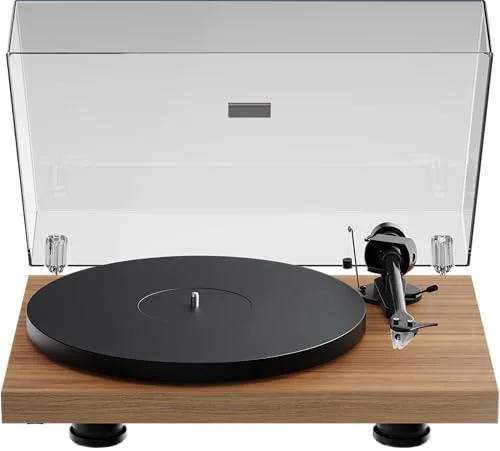
The Debut line has long been the benchmark for an affordable audiophile turntable, and the EVO is its most refined version yet. This is not a deck designed to plug into a soundbar and forget; it is built to be the source of a proper hi-fi, and it sounds it. If you are committed to records and want a deck to keep and improve for years, the EVO is where the serious listening begins, which is why it is our premium pick.
Who is the Pro-Ject Debut Carbon EVO for?
The Debut Carbon EVO is the right deck if you are serious about vinyl and have, or are building, a proper hi-fi. It is for the listener who wants to hear what their records can really do, who values build quality and an upgrade path, and who is happy to pair the deck with a separate phono stage and a capable amplifier. It rewards good speakers and careful placement, and it gives back more the better the system around it.
It is less suited to a casual or first-time buyer. It has no built-in phono preamp, so it will not work plugged straight into powered speakers, and it costs more than the rest of this list. If you are new to records or want all-in-one convenience, start with the Audio-Technica AT-LP60X or step up via the Fluance RT81. The EVO is the deck you graduate to.
How the Pro-Ject Debut Carbon EVO performs
Sound
This is the EVO's whole reason for being, and it delivers. The carbon-fibre tonearm and the heavy, damped platter keep unwanted vibration in check, and the quality Sumiko cartridge tracks the groove with real finesse. The result is a deep, quiet, three-dimensional sound that makes familiar records feel newly revealed, with detail, space and dynamics that the budget decks simply cannot reach. It is the kind of step up that justifies the leap in price for a committed listener.
Build and engineering
The EVO feels like a serious piece of kit. The plinth is dense and well finished, the platter has real heft, and the whole deck sits with a reassuring solidity that resists footfall and vibration. Pro-Ject has also added electronic speed change, so switching between 33, 45 and 78 rpm is a button press rather than the old chore of moving the belt by hand. It is engineering you can feel as well as hear.
Setup and upgrades
Setup asks more than a plug-and-play deck: you balance the arm, set tracking force and anti-skate, and pair the EVO with a phono stage and amplifier. None of it is difficult, and Pro-Ject's instructions are clear, but it is a deliberate, considered process. The upside is a deck you can upgrade, with a quality cartridge already fitted and the option to improve it further down the line. This is a platform, not a dead end.
The honest downsides: no built-in preamp, and the price
The EVO's two real drawbacks are the flip side of its ambitions. There is no built-in phono stage, so you must have an amplifier with a phono input or a separate preamp; budget for that as part of the purchase. And it is the most expensive deck here, which only makes sense once you are committed to vinyl and ready to hear the difference. Neither is a fault; both reflect a deck built for sound quality rather than convenience. If that is what you want, the EVO is worth every pound. If it is not, a simpler deck will serve you better and cost far less.